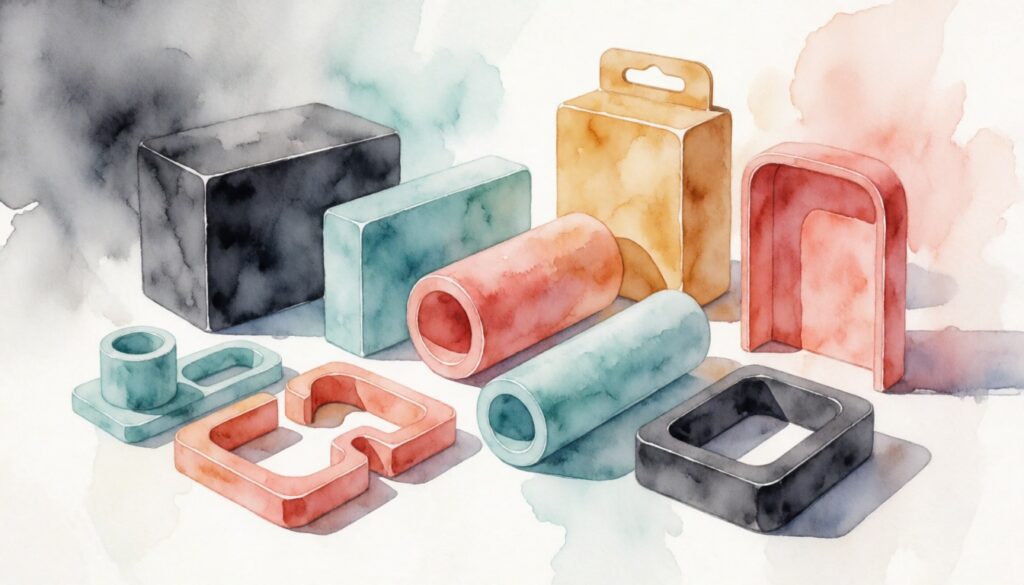
What Are Prototype Foam Parts?
Prototype foam parts are early-stage functional or visual models machined, cut, molded, or assembled from foam materials. They are used to prove fit, form, comfort, impact behavior, packaging geometry, and ergonomics before a project commits to hard tooling, higher-cost materials, or full production volumes. In many development cycles, prototype foam parts are the fastest way to turn a CAD file into a physical object that engineers, designers, and stakeholders can hold, test, and improve.
Foam prototypes are not the same as appearance models, mockups, or production foam components. An appearance model usually prioritizes surface finish and visual accuracy. A mockup may only approximate size and shape. Production foam components are made with final materials, tolerances, tooling, and quality systems. Prototype foam parts sit between concept and production: they are accurate enough for real testing, but economical and fast enough for multiple design iterations.
Typical use cases include packaging inserts, protective case liners, seating cushions, sports equipment padding, medical positioning aids, consumer product shells, gaskets, vibration dampers, and ergonomic fit checks. Engineers often choose foam for round one because it cuts 5–10x faster than aluminum or injection-molded tooling, costs far less than metal or hard plastic prototypes, and can be reshaped or recut within days. Unlike wood, foam is lightweight, compressible, and available in a wide range of densities and hardness levels. Unlike rigid plastic, it can absorb impact and conform to irregular surfaces without cracking or denting.
At COMEKIN, a prototype foam part project is defined as a complete path from CAD file to shipped sample: design review, material recommendation, DFM feedback, process selection, CNC programming or molding setup, cutting or molding, finishing, inspection, and delivery. Whether you need one foam insert for a packaging evaluation or a small pilot run of molded EPP prototypes, the goal is the same: deliver useful physical data quickly, then use that data to reduce risk before production.
Why Use Foam for Prototyping? Key Benefits
Foam is not a compromise material. It is often the smartest first step for products that must be lightweight, protective, comfortable, or ergonomic. Key benefits include:
- Speed: Foam cuts 5–10x faster than aluminum or injection-molded tooling. Simple CNC foam parts can ship in days, not weeks.
- Cost efficiency: Low material cost and no hard tooling investment for the first iteration. You can test several designs for the price of one metal prototype.
- Lightweight handling: Foam is easy to ship, carry, present, and assemble. Stakeholders and focus groups can interact with the part without safety or weight concerns.
- Cushioning and energy absorption: Foam properties are difficult to simulate with rigid materials. Drop tests, compression tests, and comfort trials reveal real-world behavior.
- Rapid design iteration: Reshape, recut, and retest within the same week. This shortens the feedback loop between engineering, marketing, and manufacturing.
- Ergonomic and fit validation: Foam is ideal for seating, wearables, helmets, footwear, and medical padding where comfort and fit are critical.
- Lower risk before steel tooling: Validate thickness, radii, draft, density, and assembly features before committing to production tooling.
For teams evaluating Prototype parts, foam offers a practical bridge between digital design and physical validation.
Common Foam Materials for Prototype Foam Parts
Material choice determines how a prototype feels, performs, and finishes. The right foam balances mechanical properties, cost, availability, and cosmetic requirements.
EPP (Expanded Polypropylene)
EPP is resilient, fatigue-resistant, and energy-absorbing. It is ideal for seating, bumpers, protective cases, automotive components, and reusable packaging. EPP prototypes can be CNC-cut or molded, depending on quantity and geometry.
EPS (Expanded Polystyrene)
EPS is the lowest-cost option for packaging inserts, volume-fit checks, and early shape validation. It is lightweight and easy to cut, but it is less durable than EPP and can crumble under repeated handling.
EVA Foam
EVA foam is soft, flexible, grippy, and available in many colors and densities. It is a go-to material for footwear, sports gear, wearable padding, craft-like assemblies, and consumer product grips.
PU (Polyurethane) Foam
PU foam is available in a wide density range and is easy to machine and finish. It works well for visual prototypes, cushioning studies, and parts that need a smooth surface or painted appearance.
XPE / PE Foam
XPE and PE foams are closed-cell, moisture-resistant, and strong. They are commonly used for gaskets, seals, industrial cushioning, flotation, and outdoor products.
Specialty Options
Memory foam, EPDM, melamine, conductive foam, and flame-retardant foams serve niche requirements such as slow recovery, weather resistance, acoustic insulation, ESD control, and fire compliance.
Density, Cell Structure, and Hardness
Density affects weight, durability, and load-bearing capacity. Cell structure influences compression set, rebound, and surface finish. Hardness, often measured by ILD or compression force deflection, determines comfort and support. A higher-density foam is not always better; it must match the application.
Material Selection Matrix
- Mechanical requirements: impact absorption, compression set, tear resistance, fatigue life.
- Thermal requirements: insulation, heat resistance, flame retardancy.
- Cosmetic requirements: color, texture, paintability, surface smoothness.
- Environmental requirements: moisture resistance, UV stability, recyclability.
- Cost and availability: sheet size, density, minimum order, lead time.
Prototyping Processes: How Foam Parts Are Made
CNC Machining
CNC routing with 3-axis and 5-axis machining produces tight-tolerance, complex 3D foam geometry. It is the most flexible process for prototypes because no hard tooling is required. COMEKIN’s engineering team can align your design with CNC machining tooling capabilities for repeatable results.
Hot Wire and CNC Hot Wire Cutting
Hot wire cutting is fast and economical for 2D and 2.5D profiles in EPS and XPE. CNC hot wire systems can cut tapered and contoured shapes, making them useful for packaging inserts and architectural mockups.
Die Cutting and Waterjet Cutting
Die cutting and waterjet cutting are effective for flat sheets, gaskets, seals, and high-volume prototype runs. Waterjet cutting avoids heat-affected zones and works well for denser foams.
Compression and Steam-Chest Molding
Compression and steam-chest molding are used for EPP and EPS bead foam prototypes. These processes create fused, repeatable parts with molded-in features, making them suitable for pilot runs and production validation.
Cast and Reaction Injection Molding
Cast and reaction injection molding (RIM) can produce PU foam parts with skin, integral color, or complex shapes. This is useful for automotive, seating, and consumer product prototypes.
Laminated and Assembled Foam Builds
Multi