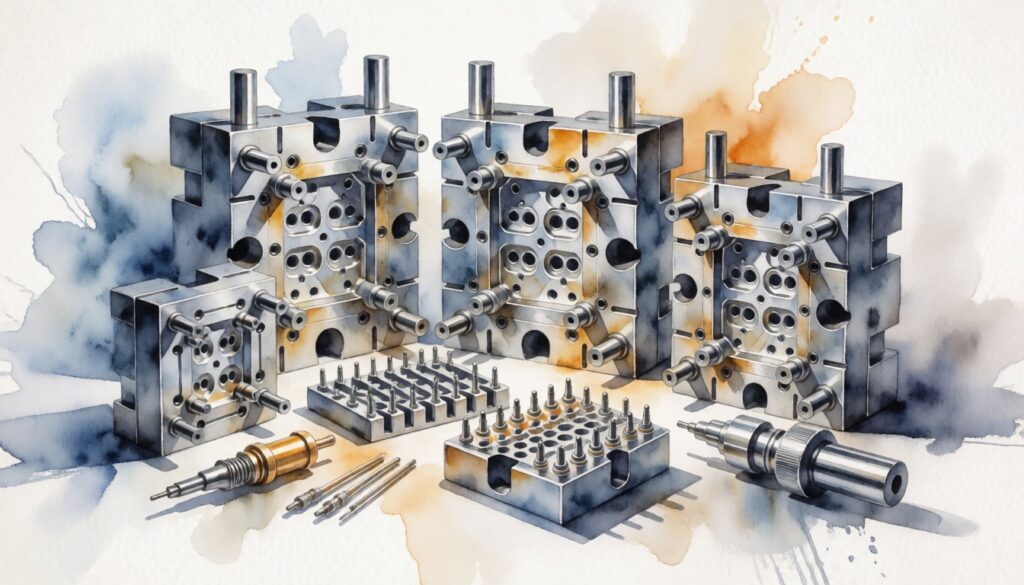
Choosing the right partner among the world’s plastic injection molds manufacturers is one of the highest-leverage decisions a product team will ever make. A mold is not a commodity purchase — it is a precision-engineered capital asset that determines whether your part fills correctly at speed, holds tolerance across millions of cycles, and ships on schedule. COMEKIN has built its reputation by treating tooling exactly that way: as the foundation of the entire manufacturing program, not a line item to be squeezed.
This guide explains what plastic injection molds manufacturers actually do, how to evaluate them, and how COMEKIN delivers precision tooling at scale — from DFM review through first approved shot and beyond.
What Do Plastic Injection Molds Manufacturers Actually Do?
The difference between a mold maker and a molder
A plastic injection mold manufacturer designs and builds the steel tooling that shapes molten resin into finished parts. A contract injection molder takes existing tooling and runs production on it. Some suppliers, including COMEKIN, do both — and that integration matters, because the team that pours your parts is the same team that signed off on your mold design.
Core deliverables
A full-service mold manufacturer typically delivers:
- Mold design and 3D CAD modeling, backed by DFM analysis
- Mold flow simulation for gate location, runner balance, and cooling layout
- Steel selection matched to resin chemistry and production volume
- High-speed CNC machining of cores, cavities, and metal mold bases
- Wire and sinker EDM for sharp corners, ribs, and hard-to-machine geometry
- Hand and spindle polishing to spec’d surface finishes (SPI A-1 through D-3)
- CNC machining tooling for electrodes, fixtures, and gauges
- Mold assembly, bench fitting, spotting, and T1 sampling
- Dimensional reports, sample inspection, and production-ready handoff
Why molds are custom-engineered capital assets
No two parts shrink, warp, or cool the same way. A 1.2 mm wall laptop housing and a glass-filled nylon under-hood bracket demand completely different gate strategies, cooling circuits, and steel hardness. Every plastic injection molds project is a one-off engineering exercise — you cannot buy a mold off a shelf the way you buy a press or a robot.
Tooling quality drives long-term part cost
Mold quality affects three cost curves simultaneously:
- Cycle time — better cooling design can cut seconds per shot; across millions of parts, that is real money.
- Scrap rate — balanced filling and rigid cores reduce short shots, flash, and dimensional drift.
- Maintenance — properly hardened, treated steel holds up to abrasive resins far longer.
How global sourcing reshaped the landscape
Over the past two decades, tooling production has globalized. Today, buyers routinely compare domestic and offshore plastic injection molds manufacturers on price, lead time, and engineering depth. The winners are suppliers who combine competitive cost structures with genuine in-house engineering — not brokers who subcontract every operation.
Why Your Choice of Injection Mold Manufacturer Decides Project Success
Tooling usually represents 15–30% of total program cost, yet it drives the majority of production risk. That asymmetry is the whole argument for vetting carefully.
Poor mold design shows up at scale
Defects rarely appear in the first hundred shots. They emerge when the tool gets hot and the press runs at rate:
- Warpage from unbalanced cooling or poor packing
- Short shots from undersized runners or cold slugs
- Flash from insufficient clamp support or worn parting lines
- Dimensional drift from inadequate core rigidity under injection pressure
The hidden cost of a cheap mold
A low quote often means softer steel, fewer cooling lines, hand-drawn water circuits, or no mold flow study. The result: longer cycle times, frequent repairs, and unplanned downtime that erases the initial savings within months.
Time-to-market impact
Tooling is on the critical path. Every design iteration, every missed T1 date, and every unapproved sample pushes launch dates and revenue. Reliable mold manufacturers hit milestones because they front-load engineering — not because they rush steel cutting.
Switching suppliers mid-program is expensive
Moving a half-built mold means re-documenting geometry, re-spotting parting lines, and absorbing schedule risk. Proper vetting up front is dramatically cheaper than a rescue project later.
Core Capabilities to Look For in a Mold Manufacturing Partner
In-house design and simulation
Demand CAD/CAE capability. A supplier that runs mold flow simulation before cutting steel can predict fill balance, weld line locations, air traps, and cooling efficiency — and fix problems on screen rather than in the tool.
Precision machining and EDM
Look for high-speed CNC mills, wire EDM for punches and inserts, sinker EDM for deep ribs, and deep-hole drilling for baffles and bubblers. Depth of equipment determines how much work is subcontracted — and how much schedule control the supplier truly has.
A complete tool room
Spotting presses, surface grinders, jig grinders, and texture/etching capability under one roof compress lead times and protect quality during final fitting.
Sampling presses
Mold manufacturers with their own injection presses can run T1 trials, produce prototype parts, and support low-volume bridge production while a production tool is still being qualified.
Change management and maintenance
Ask how engineering changes are logged, how spare cores and cavities are managed, and what preventive maintenance schedule ships with the tool.
Types of Plastic Injection Molds COMEKIN Manufactures
- Two-plate molds — the workhorse for straightforward geometries and cost-sensitive programs
- Three-plate molds — center gating for multi-cavity parts needing balanced fill
- Hot runner systems — eliminating runner scrap and reducing cycle time on high-volume runs
- Cold runner systems — economical for low volumes, heat-sensitive resins, and quick-change color programs
- Multi-cavity, family, and stack molds — maximizing output per press hour
- Unscrewing, collapsible-core, and slider-lifter designs — for threads, undercuts, and side actions
- Prototype, bridge, and production tooling — matched to each stage of a product’s life cycle
- Micro-molding and large-part molds — from precision medical components to automotive and appliance-scale tools
The Mold Manufacturing Process: From RFQ to First Approved Shot
Step 1: RFQ review and manufacturability feedback
We analyze part prints, 3D data, resin choice, and volumes — then flag risks before quoting.
Step 2: Mold flow simulation
Gate, runner, and cooling layouts are optimized and validated digitally.
Step 3: 3D mold design review
Customers approve the design at defined milestones, with full visibility into steel sizes, actions, and ejection strategy.
Step 4: Steel procurement and machining
Rough machining, heat treatment, finish machining, and EDM follow a controlled routing.
Step 5: Assembly, bench fitting, and T1
The tool is spotted, fitted, and sampled on a production-representative press.
Step 6: Inspection and final approval
Samples are measured, dimensional reports issued, corrections applied, and the mold is signed off.
Mold Steels, Materials, and Surface Treatments
Common grades include P20, 718H, NAK80, S136, H13, and 1.2344. Selection hinges on resin abrasiveness (glass-filled nylons wear steel fast), corrosiveness (PVC and flame-retardant grades attack unpolished surfaces), and required shot life.
- Pre-hardened steels (P20, 718H) — economical, good for moderate volumes
- Hardened tool steels (S136, H13, 1.2344) — for high volumes and abrasive or corrosive resins
- Treatments — nitriding, chrome plating, and DLC coatings for wear and release
- Cooling enhancements — beryllium copper inserts and conformal cooling where heat concentration is severe
Quality Control, Tolerances, and Industry Standards
Inspection relies on CMM, optical comparators, and gauge-based verification of both mold components and first articles. Mold tolerances translate directly into finished part tolerances — a tool built to ±0.01 mm holds a far tighter production window than one built to ±0.05 mm.
Documentation expectations include PPAP, FAI, ISIR, and full dimensional reports. For regulated industries, ISO 9001 and IATF 16949 certification signals a controlled quality system. Scientific molding and process capability studies (Cpk) during sampling prove the process — not just the parts.
Lead Times, Pricing, and How Mold Costs Are Calculated
Typical lead times run from a few weeks for prototype tooling to 8–16 weeks for complex production molds, depending on cavity count and finishing.
Key cost drivers:
- Number of cavities
- Steel grade and hardness
- Part complexity, undercuts, and actions
- Surface finish requirements
- Hot runner brand and manifold design
To compare quotes fairly, normalize scope: same steel, same cavity count, same hot runner make, same documentation. Then evaluate total cost of ownership — mold price versus cycle time, scrap, maintenance, and usable mold life. Lock down payment terms, tool ownership, and transfer policy in writing before purchase orders are issued.
Industries Served by COMEKIN
- Automotive interior, exterior, and under-hood components
- Medical device housings and diagnostic equipment
- Consumer electronics, wearables, and appliance parts
- Industrial equipment, power tools, and heavy-duty enclosures
- Packaging, caps, closures, and thin-wall containers
- Home goods, lawn and garden, and outdoor recreation products
How to Vet and Select a Plastic Injection Mold Manufacturer
- Request case studies, sample parts, and references from similar programs
- Audit engineering depth — DFM quality, simulation usage, and design review rigor
- Verify how much machining is in-house versus subcontracted
- Confirm communication workflow and English-language project management
- Review maintenance, spare parts, and after-sales commitments
- Check tool transfer rights and data ownership in the contract
Common Tooling Problems and How COMEKIN Prevents Them
- Warpage and shrinkage — solved through simulation-led gate and cooling design
- Cosmetic defects — weld lines, flow marks, and sinks addressed during DFM
- Long cycle times — reduced with optimized cooling and correct hot runner selection
- Wear and corrosion — managed with appropriate steel and surface treatment
- Delivery delays — avoided through milestone-based tracking and transparent reporting
Why Brands Choose COMEKIN as Their Mold Manufacturing Partner
- End-to-end service from design and tooling through molding, assembly, and shipping
- Experienced engineers delivering DFM feedback before steel is cut
- Competitive pricing without compromising steel grade or workmanship
- Dedicated project managers with single-point accountability
- Flexible engagement: tooling only, tooling plus molding, or full turnkey
- Proven track record across automotive, medical, electronics, and consumer programs
Frequently Asked Questions About Plastic Injection Molds Manufacturers
How much does a plastic injection mold cost?
Costs range widely — from a few thousand dollars for simple prototype tools to six figures for large multi-cavity automotive molds. Cavity count, steel grade, complexity, and hot runner selection move the price most.
How long does it take to build a production mold?
Typically 8–16 weeks from design approval to first shots, depending on complexity and finishing requirements.
Can COMEKIN match an existing tool or transfer a mold?
Yes. We reverse-engineer from sample parts or CAD, and we can receive, refurbish, and qualify molds from other suppliers.
What is the typical minimum order quantity after tooling?
It depends on the program — many customers start with sampling and bridge volumes before scaling to full production.
Who owns the mold?
You do, when contractual terms specify it. We recommend confirming transfer rights and data ownership up front.
What warranty or support is included after approval?
COMEKIN provides a defined support period covering tooling performance, with ongoing maintenance programs available.
Next Steps: Get a Tooling Quote from COMEKIN
Have these ready: 3D files (STEP or IGES), 2D drawings, resin specification, annual volumes, and critical tolerances. We return a quotation with DFM feedback, highlighting risks and cost drivers rather than just a number.
Response times are typically within 24–48 hours for standard RFQs. Contact COMEKIN to schedule a project consultation and put your tooling program on solid ground.