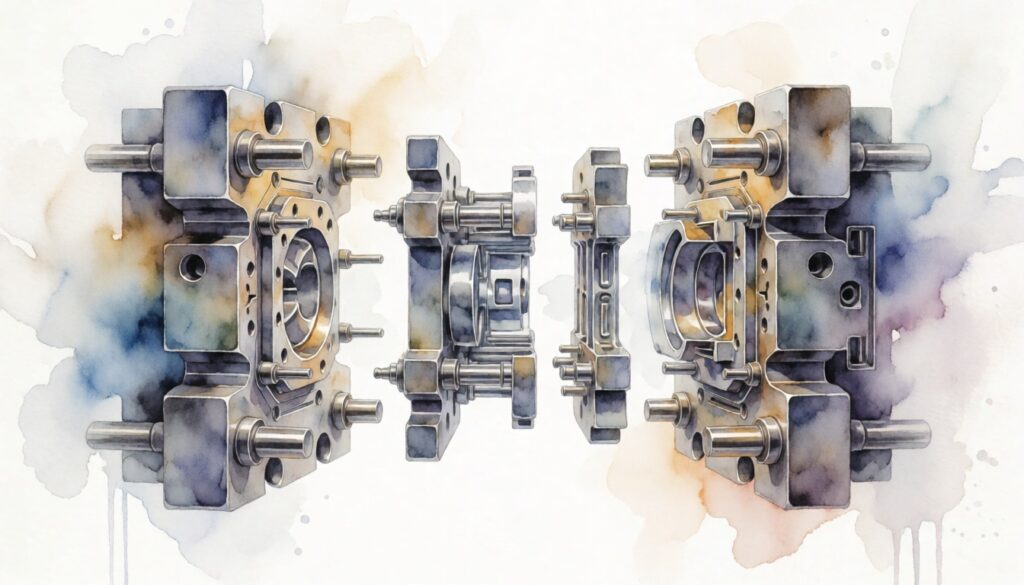
What Are Injection Plastic Molds and How Do They Work?
Injection plastic molds are precision-engineered tools, typically made from hardened steel or aircraft-grade aluminum, that contain shaped cavities designed to convert molten plastic into solid, finished parts under extremely high pressure. These molds are the heart of the injection molding process, enabling manufacturers to produce tens of thousands — or even millions — of identical components with tight tolerances, excellent surface finish, and repeatable quality.
The way an injection mold works is remarkably efficient. During each cycle, the mold closes and locks inside an injection molding machine. Plastic resin is heated until molten, then injected into the closed mold cavity under pressures that can exceed several thousand psi. The resin fills every detail of the tool, from fine textures to complex internal features. Next, the cooling phase begins: the mold is chilled by precisely routed coolant channels so the plastic solidifies quickly and uniformly. Finally, ejector pins push the finished part out of the cavity, and the mold closes again for the next cycle.
This repetitive cycle — clamping, injection, cooling, ejection, and repeat — is what makes injection molding one of the most cost-effective manufacturing methods for large production runs. The performance, efficiency, and end-product quality of that entire system depend almost entirely on one thing: the quality of the plastic injection molds themselves.
Common Types of Injection Plastic Molds
Not every part design needs the same mold architecture. Injection molders and product engineers choose from several mold types based on part complexity, production volume, material, and budget.
Two-Plate Molds
The two-plate mold is the simplest and most economical style. It consists of a cavity plate and a core plate that separate at the parting line. The runner system and gate are located along that parting line, making the tool easy to build, maintain, and run. Two-plate molds are ideal for a wide range of general-purpose parts, including housings, caps, brackets, and simple structural components.
Three-Plate Molds
When a part has complex geometry that requires more than one gate or a centered gate location, a three-plate mold offers a better solution. This design uses an additional plate to allow the resin to flow through multiple gates before entering the cavity. The runner system can automatically separate from the part when the mold opens, which reduces manual labor and improves cycle consistency. Three-plate molds are slightly more expensive and require more careful maintenance, but they deliver superior flexibility for intricate plastic parts.
Hot Runner Molds
Hot runner molds use a heated manifold system to keep the plastic in the runner channels molten throughout the entire cycle. Since the runner never cools and solidifies, material waste is dramatically reduced — a significant advantage for expensive engineering resins. Hot runner systems also shorten cycle times and eliminate the need for secondary runner removal. They are commonly used in high-volume consumer, automotive, and medical applications where material savings and speed are critical.
Stack Molds
Stack molds take productivity to the next level by molding multiple layers of parts in a single machine cycle. The mold uses two or more parting planes, effectively doubling or tripling output without increasing clamping tonnage proportionally. Stack molds are an excellent investment for ultra-high-volume products where press capacity is a bottleneck.
Insert Molds and Overmolding
Insert molding and overmolding support multi-material designs, threaded components, and embedded-metal applications. In insert molding, pre-placed items such as brass inserts or metal pins are loaded into the cavity, and plastic is molded around them. Overmolding involves molding a second material — often a soft-touch elastomer — over a previously molded plastic substrate. Both approaches allow designers to combine unique tactile, structural, and mechanical properties into a single assembled component.
Key Mold Materials for Injection Plastic Molds
The material chosen for an injection mold determines its lifespan, production capacity, part quality, and maintenance requirements. Selecting the right steel or aluminum grade is critical.
Pre-Hardened Tool Steels
For standard production runs, pre-hardened grades such as P20 and H13 are common choices. P20 offers good machinability and toughness, while H13 excels in high-heat and high-wear applications. Both provide the strength and wear resistance needed for reliable long-term performance.
Hardened Tool Steels
For very high-volume production or corrosive resin formulations, hardened tool steels like S7 or 420 stainless steel deliver significantly longer tool life. Hardening increases the mold’s resistance to abrasive fillers, such as glass fibers, and minimizes damage from repeated cycling and part ejection.
Aluminum Prototype Molds
Before committing to expensive production tooling, many product teams turn to aluminum molds. Aluminum provides outstanding thermal conductivity, which accelerates cooling and shortens cycle times, but it is softer than steel and wears faster. That makes it ideal for prototype parts, pilot runs, and low-volume manufacturing — engineers can validate designs, make adjustments, and refine products before cutting expensive steel tooling.
Surface Treatments and Finishes
Regardless of base material, surface engineering can dramatically improve mold performance. Nitriding hardens the surface layer, while specialized coatings like PVD or chrome enhance corrosion resistance and release properties. Super polishing reduces mold wear and improves the cosmetics of clear and high-gloss parts.
Injection Mold Design Principles for Reliable Parts
An injection mold is only as good as its design. Following established design principles helps technicians create tools that fill consistently, cool evenly, and eject cleanly every single cycle.
Uniform Wall Thickness
Part walls should be as consistent as possible. Thick and thin sections cool at different rates, which commonly causes sinks, voids, warpage, and internal stress. Where variations are unavoidable, designers should blend transitions gradually.
Draft Angles
Vertical surfaces in the mold must include slightly angled draft to help the part release during ejection. Without draft, parts stick to the cavity, causing scratches, distortion, or even catastrophic damage to the part and tool. Even a modest 0.5 to 2 degrees of draft makes a significant difference.
Gate and Runner Design
Gate location and runner balance dictate how the molten resin flows. Poor design can produce weld lines, short shots, trapped air, or excessive pressure loss. Properly sized runners feed every cavity evenly, allowing multiple cavities to fill simultaneously with consistent packing.
Cooling Channel Layout
Cooling is responsible for the majority of cycle time in injection molding. Well-placed conformal or straight cooling channels pull heat out evenly, reducing cycle time and minimizing shrinkage and dimensional variation.
Mold Flow Analysis
Modern mold engineering increasingly relies on CAE mold flow simulation. Simulating filling, pressure, flow front temperature, and cooling behavior before any steel is cut helps identify potential quality defects early. Mold flow analysis is an invaluable tool for de-risking tooling — especially before investing in complex or expensive metal mold bases and multi-cavity architecture.
COMEKIN’s Custom Injection Mold Manufacturing Process
At COMEKIN, building a world-class injection mold requires equal parts engineering precision, advanced manufacturing capability, and disciplined quality control. Each project moves through a proven, transparent workflow.
Design Review and Feasibility Study
Every project begins with a thorough design review. Our engineers evaluate part manufacturability, suggest improvements for wall thickness and draft, simulate shrink rates, and recommend a mold architecture that fits your production volume and budget. This early consultation prevents costly surprises later.
Precision CNC Machining and EDM
Once the design is validated, manufacturing begins. COMEKIN uses advanced precision CNC machining equipment, electrical discharge machining (EDM), and specialized CNC machining tooling to cut cavities, cores, slides, and inserts to exact specifications. Additional finishing techniques, from precision drilling of cooling channels to final grinding and polishing, ensure every surface meets its requirements.
Assembly and Fitting
Fully machined mold components are brought to the mold base assembly stage. Expert mold makers hand-fit slides, lifters, ejector systems, and inserts so that all movements are smooth and every steel-to-steel seal is tight. Gates and runners are polished to achieve the required flow characteristics and parting line quality.
Trial Runs and Sampling
When the mold is fully assembled, we run trial shots under production conditions. The primary goals are to validate part quality, identify any cosmetic or dimensional imperfections, and optimize cycle parameters. If adjustment is required — whether for venting, ejection, or gate geometry — engineering makes the change before final approval.
Dimensional Inspection
Before shipping, every mold receives rigorous verification using coordinate measuring machines (CMM). Detailed dimensional reports confirm the mold conforms to the approved part data, and documented quality control records ensure you know exactly what you are receiving.
Industries That Rely on Injection Plastic Molds
Injection plastic molds power manufacturing across virtually every industry that uses plastic components. COMEKIN’s custom molds support a diverse range of sectors:
- Automotive: Manufacturers depend on injection molds for interior trim panels, dashboard components, electrical connectors, housings, and durable under-the-hood parts that must withstand heat, vibration, and chemical exposure.
- Electronics and Appliances: Semiconductor housings, display frames, connectors, cable strain reliefs, and internal structural brackets demand high precision, tight tolerances, and consistent electrical insulating properties.
- Medical Devices: Medical product development requires clean, clean, repeatable molds for instrument housings, diagnostic consumables, surgical handles, and disposable components — often produced from specialized materials in tightly controlled environments.
- Consumer Products: Household items, packaging, personal care containers, toys, and outdoor gear all rely on custom injection molds to balance aesthetics, durability, and cost-effective production.
Quality Control and Maintenance of Injection Molds
Molds represent a significant long-term investment. A well-maintained injection mold can last for decades, while neglected tooling can wear down, rust, or fail prematurely.
Preventive Maintenance
A structured preventive maintenance program tracks wear on slides, cores, ejector pins, and hot runner components. Regular inspections, cleaning, rust protection, and lubrication keep the tool operating at peak performance and prevent unplanned downtime.
Cleaning and Rust Protection
Residual plastic, mold release agents, and airborne contaminants can accumulate on tool surfaces, leading to imperfect parts and corrosion. Thorough cleaning at scheduled intervals — followed by application of rust inhibitors — protects polished steel surfaces, especially when the mold is stored between production campaigns.
Process Validation and Sampling
Periodic sampling and process validation check that the mold still produces parts within specification. Monitoring cavity pressure, temperature profiles, and dimensional outputs over time can reveal subtle wear patterns before they create scrap.
Proper Mold Storage
Storing molds vertically or in purpose-built racks with proper protection reduces the risk of damage, moisture, and contamination. Preserving tooling correctly between runs directly reduces long-term repair and maintenance costs.
How to Choose an Injection Plastic Mold Manufacturer
Choosing the right partner for your injection mold project is one of the most consequential decisions you will make as a product developer or manufacturer. The right mold supplier lowers production risk, shortens time to market, and ensures part consistency for years to come.
What to Look For in a Mold Supplier
Look beyond price. A capable manufacturer should demonstrate:
- Engineering experience with DFM feedback, gating best practices, and mold flow analysis.
- Precision equipment including advanced CNC machines and EDM capable of tight-tolerance hardware molds and complex geometries.
- Quality systems with documented inspection procedures and dimensional reporting.
- Turnkey capabilities in mold design and complete injection plastic molds manufacturing.
- Clear communication about project timelines, mold sampling, part testing, and post-delivery support.
The COMEKIN Advantage
COMEKIN is a leading provider of custom injection plastic molds engineered to match precise part requirements, production quantities, and quality targets. By partnering with a mold builder that understands plastic flow, cooling behavior, tool steel selection, and precision machining — and that can stand behind its work with measurable quality standards — you reduce risk and accelerate every step from prototype to full-scale production. A strong mold partner doesn