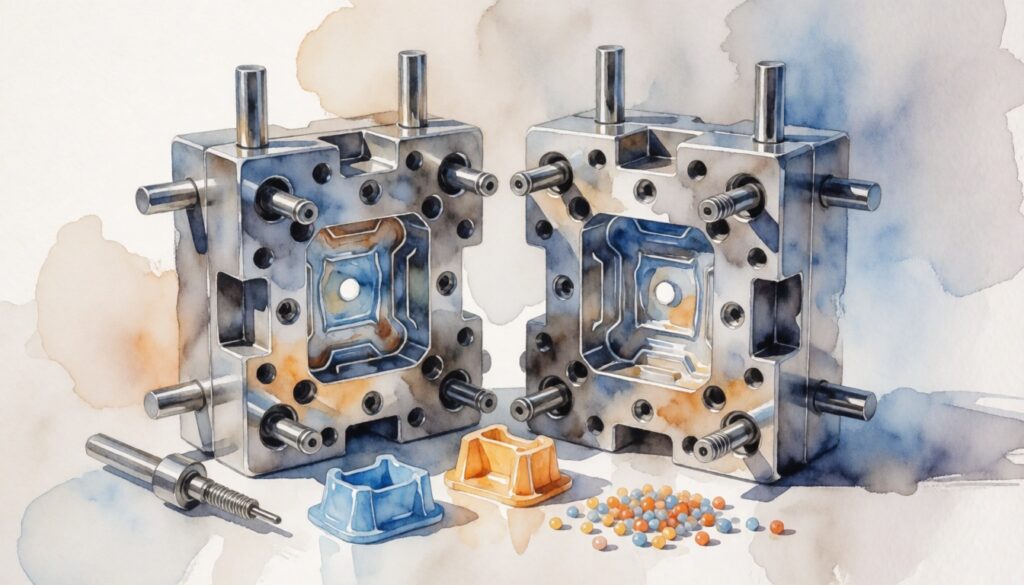
Introduction: Why Molds for Plastic Injection Matter
Injection molding is one of the most efficient ways to produce plastic parts at scale. The process forces molten plastic into a precision-machined tool, where it cools and solidifies into the desired shape. At the center of this process are molds for plastic injection—the custom tools that determine part geometry, surface finish, dimensional accuracy, and production speed.
A well-designed injection mold enables precision, repeatability, and mass production. It allows manufacturers to produce thousands or millions of identical parts with tight tolerances, consistent quality, and predictable cycle times. A poorly designed mold, on the other hand, can cause warpage, short shots, sink marks, excessive scrap, and costly downtime.
COMEKIN is a trusted partner for injection mold design and manufacturing, serving customers who need reliable tooling for prototypes, bridge production, and high-volume programs. COMEKIN combines engineering expertise, in-house manufacturing, and global project support to deliver Plastic injection molds that perform from first sample to end of life.
This guide explains what injection molds are, how they work, the main mold types and materials, cost factors, maintenance best practices, and How to Choose the right supplier. Whether you are launching a new product or transferring an existing mold, understanding these fundamentals will help you make better decisions.
What Are Molds for Plastic Injection?
A plastic injection mold is a precision tool made from metal or specialty materials. It contains one or more cavities shaped like the finished part, along with cores, runners, gates, cooling channels, and an ejection system. When the mold closes, molten plastic is injected into the cavity under high pressure. The plastic cools, the mold opens, and the part is ejected.
Key Components of a Plastic Injection Mold
- Cavity and core: The cavity forms the outer shape of the part, while the core forms internal features.
- Runner system: Channels that guide molten plastic from the injection nozzle to the cavities.
- Gates: Small openings that control how plastic enters each cavity.
- Cooling channels: Internal passages that circulate water or oil to remove heat.
- Ejection system: Pins, sleeves, strippers, or lifters that push the finished part out of the mold.
- Mold base: The structural frame that holds the cavity, core, and all supporting plates. COMEKIN manufactures durable Metal mold bases for demanding production environments.
- Venting: Tiny gaps or channels that allow trapped air and gases to escape.
Industry Terms Clarified
The words tooling, mold, die, and cavity are often used interchangeably, but they have distinct meanings. Tooling is a broad term for manufacturing tools, including molds, jigs, and fixtures. A mold is the specific tool used for injection molding. A die is more commonly used in stamping, casting, or extrusion. A cavity is the individual hollow space that forms one part or a set of parts.
Types of Molds for Plastic Injection
Two-Plate, Three-Plate, Hot Runner, and Cold Runner Molds
A two-plate mold is the most common design. It opens along a single parting line and is cost-effective for many applications. A three-plate mold adds a second parting line, allowing the runner to separate automatically from the part—useful for center-gated parts.
Cold runner molds let plastic solidify in the runner before ejection. They are simpler and often less expensive, but they generate scrap. Hot runner molds keep plastic molten in the runner system, reducing waste and improving cycle time. They cost more upfront but can deliver strong long-term savings in high-volume production.
Family, Multi-Cavity, and Single-Cavity Molds
- Single-cavity molds produce one part per cycle. They are suitable for large parts, low volumes, or complex geometry.
- Multi-cavity molds produce multiple identical parts per cycle. They reduce per-part cost but require balanced filling and cooling.
- Family molds produce different parts in one cycle, often for products that are assembled together. They can reduce tooling cost but may create production scheduling challenges.
For compact or space-constrained applications, COMEKIN also offers compact injection molds for small spaces that maintain precision without sacrificing productivity.
Prototype, Bridge, and Production Molds
Prototype molds are built for speed and design validation. They may use aluminum or lower-grade steel and are ideal for limited runs. Bridge molds fill the gap between prototype and full production, often using production-grade materials but simplified designs. Production molds are built for high volumes, tight tolerances, and long service life. COMEKIN supports early-stage programs with rapid Prototype parts and scalable production tooling.
Specialized Molds
Specialized designs include overmolding molds, which bond a second material onto a substrate; insert molding molds, which encapsulate metal or plastic inserts; and stack molds, which use multiple parting planes to multiply output within a single machine cycle.
Core Components and Mold Design Essentials
Part Design, CAD Modeling, and Mold Flow Analysis
Successful injection molding starts with part design. CAD models define geometry, wall thickness, ribs, bosses, and tolerances. Mold flow analysis simulates how plastic will fill the cavity, predicting fill pressure, temperature, weld lines, air traps, and cooling behavior. This step reduces trial-and-error and prevents costly mold revisions.
Gate, Runner, and Cooling System Design
Gate location affects part quality, cycle time, and cosmetic appearance. Runners must balance flow to each cavity so all parts fill simultaneously. Cooling channels should be placed close to hot plastic areas without compromising structural integrity. Uniform cooling minimizes warpage and shortens cycle time.
Draft, Wall Thickness, Tolerances, and Shrinkage
Draft angles allow parts to release cleanly from the mold. Wall thickness should be consistent to avoid sink marks and voids. Tolerances must be realistic for the resin and process. Shrinkage compensation is built into the mold dimensions because all plastics shrink as they cool.
Ejection, Venting, and Surface Finish
Ejection systems must push parts out without deformation. Venting prevents trapped gas from causing burns or incomplete fill. Surface finish can range from glossy to textured, depending on product requirements. Precision CNC machining tooling helps achieve these critical details.
Materials Used in Injection Mold Manufacturing
Common Tool Steels
- P20: A pre-hardened steel used for general-purpose molds and moderate production volumes.
- H13: A hot-work steel with excellent toughness and heat resistance, suitable for high-volume and engineering resins.
- S136: A stainless steel with corrosion resistance and good polishability, often used for medical and optical parts.
- NAK80: A pre-hardened steel with excellent mirror finish and dimensional stability.
Aluminum for Prototype and Bridge Tooling
Aluminum molds are lightweight, fast to machine, and cost-effective for prototype or bridge production. They are not ideal for high-volume runs or abrasive resins, but they allow quick design validation and market testing.
Specialty Materials
Beryllium copper is sometimes used for cores or inserts where rapid cooling is needed. It conducts heat much faster than steel, reducing cycle time in thick sections. Other specialty materials include hardened inserts, wear-resistant coatings, and corrosion-resistant alloys.
How Material Selection Is Decided
Resin type, production volume, part complexity, tolerance requirements, and durability all influence material selection. A medical device mold may require stainless steel for cleanliness. A high-volume automotive mold may require hardened H13. A prototype mold may use aluminum to save time and cost.
The Injection Mold Manufacturing Process at COMEKIN
DFM Review and Mold Flow Analysis
Before manufacturing begins, COMEKIN performs a Design for Manufacturing (DFM) review. Engineers examine part geometry, wall thickness, draft, gate locations, and ejection strategy. Mold flow analysis validates filling, cooling, and warpage predictions. This early review prevents costly changes later.
CNC Machining, EDM, Wire EDM, and Grinding
COMEKIN uses advanced machining processes to produce mold components with high accuracy. CNC machining creates complex geometries. EDM and wire EDM cut hard materials and fine details. Grinding achieves tight tolerances and smooth surfaces. Related precision methods such as drilling and grinding are also part of a complete tooling strategy.