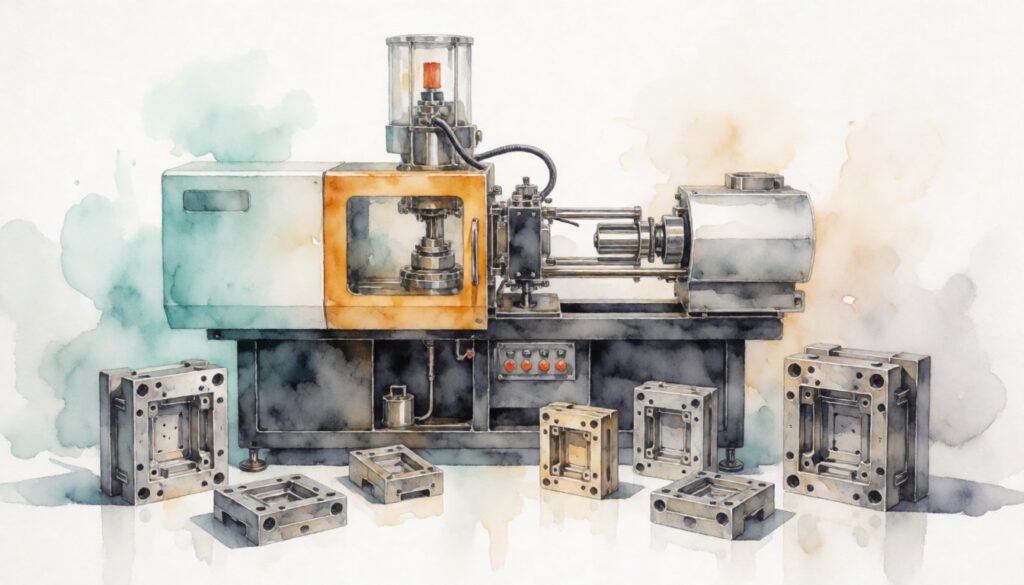
Why Small Spaces Demand Specialized Injection Molds
When you’re running a job shop, an R&D lab, or a lean manufacturing cell, every square foot of floor space matters. Traditional mold frames and bulky auxiliary equipment can turn a once-efficient workflow into a logistical nightmare—especially when you’re trying to squeeze a production line into a corner of your workshop. That’s exactly why the search for the Best Injection Plastic Molds for Small Spaces 2026 is more than a trend. It’s a strategic response to the realities of modern, space-constrained manufacturing.
Compact molds do more than just fit. They reduce setup time, let operators run multiple machines side-by-side in tight production cells, and eliminate the clutter that kills productivity. When you pair a space-efficient mold with a benchtop or mini injection molding machine, you create a micro-factory that maximizes every inch of your facility.
What you gain with space-conscious tooling:
- Reduced overhead costs by making productive use of previously wasted floor area.
- Improved material flow and operator movement with less congestion around each press.
- Ability to run more machines simultaneously without expanding your facility.
“Low-floor-space tooling” is no longer a niche selling point. In 2026, it’s a core requirement for agile manufacturers who want to stay competitive without paying for a bigger building.
The takeaway: If you’re serious about maximizing production in a minimal footprint, investing in the right plastic injection molds is your single biggest lever.
Key Features to Look for in Compact Injection Molds
Not every “small mold” is truly optimized for tight spaces. To get the best results, you need to look beyond physical size and focus on engineering features that support compact production environments.
Small Footprint Frame Designs
A true compact mold doesn’t just have smaller dimensions—it’s designed with a frame that mounts easily on benchtop and mini injection molding machines. Look for molds with simplified ejection systems, reduced plate thickness, and streamlined bases that don’t require oversized support structures. Metal mold bases that are precision-ground and hardened give you the durability of a full-size frame without the bulk.
Quick-Change Inserts and Multi-Cavity Layouts
When space is at a premium, you can’t afford downtime for complex changeovers. Quick-change inserts allow you to swap part geometries in minutes, while multi-cavity layouts let you produce more parts per cycle without increasing the machine’s footprint. This is especially valuable for low-volume production runs where flexibility is just as important as output.
Integrated Cooling Channels
Efficient cooling is critical in any injection molding process, but in a compact mold, space constraints make it even more challenging. Integrated cooling channels—conformal or near-contour—improve heat transfer and shorten cycle times, all while maintaining part quality. A well-cooled compact mold can outperform a larger, poorly cooled tool in both speed and dimensional stability.
Precision Machining and Surface Finish
Small molds are often used for high-tolerance components. That means gating, venting, and ejection must be machined with extreme precision. Working with a partner that offers in-house CNC machining tooling ensures your compact mold delivers the surface finish and part accuracy your customers expect.
Top COMEKIN Mold Solutions for Small-Space Production
COMEKIN has built its reputation on delivering high-performance molds that don’t compromise on quality, even when the footprint is tight. Here are the standout options for 2026.
Compact Two-Plate Molds
The simplest and most reliable solution for small spaces is a well-engineered two-plate mold. COMEKIN’s compact two-plate designs are known for their easy mounting, straightforward maintenance, and robust performance. They fit seamlessly onto mini and benchtop presses, making them an excellent choice for injection molds for plastic product development and short-run production.
Stack Molds for Doubled Output
If you need greater output but can’t expand your machine footprint, stack molds are the answer. COMEKIN’s stack mold technology allows you to double your cavity count without increasing clamping force or machine size. The result? Twice the parts per cycle from the same small press—a game-changer for space-constrained operations that want to scale quickly.
Custom Mini Molds
No two products are exactly alike, and sometimes off-the-shelf tooling just won’t cut it. COMEKIN specializes in custom mini molds engineered for specific part geometries and low-volume production runs. Whether you need a simple prototype or a production-ready tool, the team can design a compact mold that fits your machine, your part, and your available floor space.
Pro tip: Need rapid validation before committing to production tooling? Take advantage of COMEKIN’s prototype parts services to test your design before the mold is finalized.
For more perspective on how advanced mold designs continue to evolve, be sure to check out our guide on molds for plastic injection.
How to Optimize Your Small-Space Mold Layout
Even the best compact mold won’t help if your overall layout is poorly planned. Here’s how to get the most out of your small-space production floor:
Position Molds and Auxiliary Equipment for Ergonomics
Place the mold, material dryer, and temperature controller in a logical sequence that minimizes operator movement. Ideally, the operator should be able to load raw material, start the cycle, and remove finished parts without taking more than a step or two. This creates an ergonomic workflow that reduces fatigue and increases consistency.
Use Vertical Storage Racks and Mold Carts
Molds that aren’t in use should never sit on the production floor. Invest in vertical storage racks to organize tooling vertically rather than horizontally, and use mold carts to move molds between the storage area and the press. This keeps the floor clear and reduces the risk of damaging expensive tooling.
Plan Maintenance Access Around Mold Installation
A common mistake in small shops is squeezing a mold into a space where it’s impossible to access for maintenance. Always leave enough clearance around each press for operators to remove bolts, connect coolant lines, and inspect the mold. If you can’t reach it, you can’t maintain it—and an unmaintained mold will fail early.
For additional guidance on keeping your tooling in peak condition, don’t miss The Ultimate Guide to Grinding in 2026 for maintenance tips that extend mold life.
Maintenance and Safety Tips for Compact Molds
Small molds may be easier to handle than large ones, but they still require disciplined maintenance. In a tight space, neglecting upkeep can quickly turn into costly downtime.
Follow a Regular Cleaning and Lubrication Schedule
Compact molds—because of their tighter clearances and closer component spacing—are more susceptible to flash and premature wear if debris or old release agents accumulate. Implement a scheduled cleaning routine for parting lines, ejector pins, and guide components. A thin, consistent application of the right mold release and lubricant protects surfaces and keeps cycles running smoothly.
Use Lift Assists and Compact Handling Systems
Even a “small” mold can be heavy and awkward to position. Use lift assists, telescopic slides, or compact mold handling systems to reduce operator strain. This is especially important in confined spaces where there’s less room to maneuver.
Keep Safety Guards and Light Curtains in Place
When space is limited, there’s often a temptation to remove safety guards so you can reach the mold more easily. Don’t do it. Safety guards and light curtains protect operators from moving platens, injection units, and ejector systems. In fact, well-designed compact molds are meant to work with safety equipment, not around it. Always prioritize operator safety, even when space is tight.
You can also explore hardware molds for durable tooling solutions that hold up well under frequent maintenance cycles.
Choosing the Right COMEKIN Mold for Your Small Space in 2026
Selecting the best injection plastic mold for a compact workspace isn’t just about picking the smallest option. It requires a strategic evaluation of your machine, your product, and your production goals.
Evaluate Machine Parameters First
Before choosing a mold, verify the specifications of your injection molding machine:
- Platen size and tie-bar spacing determine the maximum mold footprint.
- Clamping force must be sufficient to hold the mold closed during injection.
- Shot capacity must match the part weight plus the runner system.
If you’re working with a mini press, these parameters are especially critical. A mold that’s too large for the platen won’t mount properly, and a mold that requires more clamp force than the press can deliver will produce flash and short shots.
Work with COMEKIN Engineers on a Custom Concept
No one knows your product like you do, but COMEKIN’s engineers bring decades of experience in designing compact tooling for space-limited operations. They can help you develop a custom compact mold concept that accounts for your part geometry, material choice, and daily output targets. Whether you need a two-plate design or a stack mold, their team will optimize the tool’s architecture for your specific constraints.
For more insight into how different plastic molding technologies compare, read our detailed guide on injection plastic molds.
Compare Mold Cost, Cycle Time, and Maintenance Requirements
The cheapest mold isn’t always the most cost-effective, especially in a small-space environment. Consider the total cost of ownership, which includes:
- Initial mold cost and lead time.
- Cycle time and how it affects your hourly output.
- Maintenance frequency and the labor cost of servicing in a cramped space.
- Long-term durability and how many parts the mold can produce before requiring repair.
A slightly higher upfront investment in a precision-engineered COMEKIN mold often pays for itself through shorter cycles and reduced maintenance downtime.
Final Thoughts: Small Space, Big Results
The best injection plastic molds for small spaces in 2026 are not just compact—they are intelligent, durable, and perfectly aligned with your production goals. COMEKIN offers a complete range of plastic injection molds, metal mold bases, and custom tooling designed to help you get the most from every square foot.
Whether you’re prototyping a new product, running a low-volume production line, or expanding into a new niche, space-efficient molds are the key to unlocking higher output without the overhead of a larger facility. And for even more information on specialty tooling like rotational or blow molding approaches, our Ace Hardware Blow Molds article offers a fascinating look at alternative methods.
Ready to find the perfect compact mold for your shop? Contact COMEKIN today and let their engineers design a solution that fits your space, your budget, and your production targets.
📖 Related Reading:
📖 Related Reading: