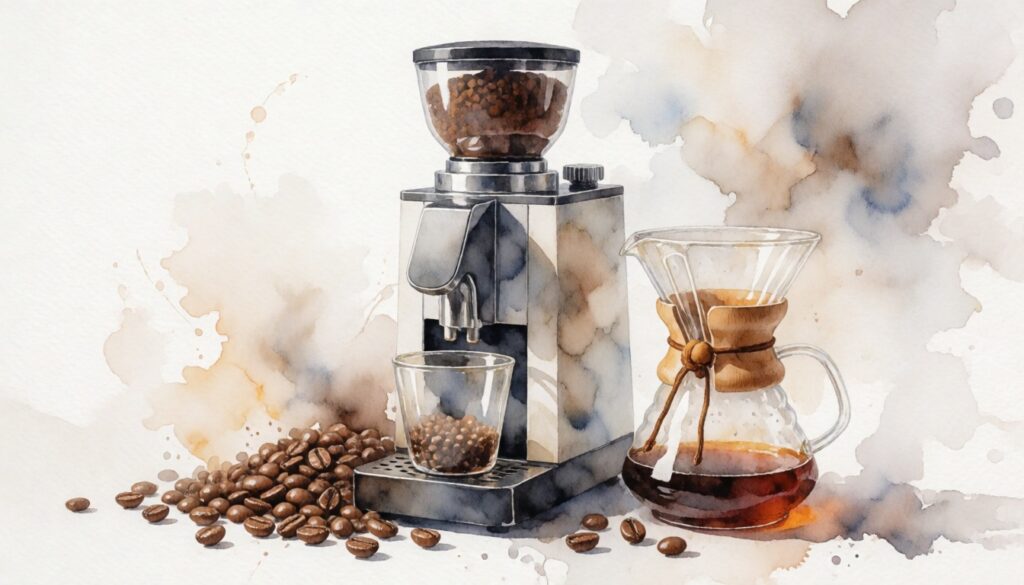
Introduction to Grinding Machine Coffee Guide: How COMEKIN Helps You Brew Better
Great coffee rarely happens by accident. Before the water touches the grounds, before the first aromatic bloom rises from the dripper, a machine has already made the single most important decision in the entire brewing chain: the consistency of the grind. That is why this Grinding Machine Coffee Guide: How COMEKIN Helps You Brew Better exists — to connect the engineering behind the burr set with the flavor in your cup, and to show how a manufacturing partner like COMEKIN quietly shapes both.
Whether you are a home enthusiast chasing a cleaner pour-over, a café owner standardizing extraction across three grinders, or a product developer sourcing components for a new grinder line, the principles are identical. Grind uniformity controls surface area. Surface area controls extraction rate. Extraction rate controls whether your cup tastes sweet and balanced or muddy, sour, and hollow. Everything else — dose, temperature, ratio, technique — is a supporting actor.
Why This Guide Matters for Modern Growth
The specialty coffee market has moved past the era when "freshly ground" alone was a selling point. Today’s buyers compare burr geometry, particle distribution charts, static retention figures, and motor torque specs the way they once compared roast dates. For brands, that shift creates both pressure and opportunity: the grinder is no longer a commodity accessory but a premium, spec-driven product that customers research intensely before purchasing.
That means the companies who manufacture grinder components — burr carriers, adjustment collars, hoppers, motor mounts, and housings — carry real influence over the final brew quality. Precision manufacturing is not a back-office detail. It is the reason one grinder delivers a repeatable espresso shot at setting 4.2 and another drifts unpredictably between 4.0 and 4.5.
Key Market Trends and Foundational Concepts
Three trends define the 2026 grinding landscape:
- Burr-first buying behavior. Consumers now choose flat vs. conical burrs, coated steel vs. titanium nitride, and 64mm vs. 83mm diameters before they even look at the housing design.
- Single-dosing and low retention. Home baristas want near-zero retention, which demands tighter tolerances in the grind chamber and discharge chute.
- Repairability and modularity. Buyers want to replace a burr set or a worn adjustment mechanism instead of discarding the whole machine — a design philosophy that depends on precisely molded and machined interchangeable parts.
Each of these trends points back to manufacturing fundamentals: dimensional accuracy, material consistency, and repeatable tooling.
How COMEKIN Optimizes This Strategy
COMEKIN approaches coffee grinding equipment the way it approaches any precision industrial program — with tooling, tolerance control, and prototyping discipline. Grinder housings and hoppers benefit from Plastic injection molds that hold crisp wall thicknesses and stable shrinkage across high-volume runs. Structural frames, motor brackets, and burr carriers rely on Metal mold bases and Hardware molds to keep alignment within microns so the burr axis never wobbles. Adjuster threads and burr mounting surfaces are produced with CNC machining tooling, where surface finish directly translates into grind consistency.
Before any of that reaches production, developers validate concepts through Prototype parts, testing burr spacing, chute geometry, and static behavior on real benchtops rather than in theory. For a deeper look at machine selection and buyer criteria, the grinding coffee maker guide covers the consumer-facing side, while the complete coffee grinding machine overview addresses broader equipment categories.
Core Benefits & Strategic Importance
Driving Targeted Audience Engagement
A grinder that performs consistently earns reviews, repeat purchases, and word-of-mouth recommendations. Consistency is measurable: when particle size distribution stays tight across a full hopper, users taste the difference in the cup and report it. Brands that can demonstrate tolerance data, burr alignment specs, and retention figures connect far more convincingly with an audience that has grown skeptical of marketing language.
Engagement also comes from education. Content that explains why burr alignment matters, why a plastic hopper’s material choice affects static buildup, and why thread pitch influences micro-adjustability builds trust. That trust converts readers into buyers and buyers into advocates.
Maximizing ROI and Conversion Efficiency
Precision manufacturing is a cost-efficiency strategy, not just a quality strategy. Well-designed Plastic injection molds reduce cycle time, scrap rate, and post-processing labor on hoppers and housings. Proper Metal mold bases extend tool life so amortized cost per part falls as volume rises. When burr carriers are machined accurately from the start, you eliminate the rework loop that quietly destroys margins.
The downstream ROI is even clearer: fewer warranty claims, fewer returns driven by "it grinds unevenly," and a stronger average review score that lowers customer acquisition cost across every channel.
Avoiding Common Pitfalls and Mistakes
Most grinding problems trace back to a short list of avoidable errors:
- Ignoring burr alignment. A perfectly good burr set inside a misaligned carrier produces mediocre results. Alignment must be designed in, not adjusted in.
- Underspecifying materials. Cheap plastics deform under motor heat; soft metals wear at the adjustment interface. Both cause grind drift over months of use.
- Skipping prototype validation. Testing only at final tooling means expensive corrections. Prototype parts catch geometry and retention issues early.
- Overlooking static and retention. Chute and chamber geometry determine how much coffee stays behind. Small design changes have large impacts.
- Chasing burr size alone. Diameter helps throughput, but uniformity comes from alignment, runout, and cutting-edge quality.
- Neglecting user calibration. Even a superb grinder needs a clear dialing-in workflow. Users who cannot repeat a setting will blame the machine.
Step-by-Step Implementation Guide
Initial Audit and Foundational Setup
Start by benchmarking what you have. For equipment owners, that means measuring grind consistency across the dial, weighing retention after each dose, and recording extraction times at fixed dose and ratio. For product teams, it means auditing current drawings, tolerance stacks, and tooling condition.
Foundation work includes:
- Define the target particle distribution for the grinder’s primary use case (espresso, filter, or all-purpose).
- Establish critical-to-quality dimensions — burr mounting face flatness, shaft runout, adjustment thread pitch, chamber clearance.
- Review material selection for heat resistance, wear resistance, and food-contact compliance.
- Confirm the tooling base: Hardware molds and Metal mold bases should be validated against the tolerance stack before cutting steel.
- Document the calibration workflow so users can reproduce a setting.
Executing High-Impact Action Items
With the baseline set, move to the changes that move the needle most:
- Tighten burr carrier tolerances. This is the highest-leverage improvement for grind uniformity. Machined carriers produced with CNC machining tooling reduce axial play and keep the cutting edges parallel.
- Redesign the discharge path. Smooth transitions and anti-static materials reduce retention and mess. Tooling updates through Plastic injection molds make this change production-ready quickly.
- Refine the adjustment mechanism. Micro-stepped collars with defined detents let users return to a known setting instead of hunting for it.
- Validate with prototypes. Build and test revised chambers, chutes, and carriers using Prototype parts before committing to production tooling.
- Standardize the dialing-in routine. Publish a short, repeatable method: purge a small dose, weigh output, adjust in small increments, taste, and record.
- Address thermal stability. Motors generate heat; housings and mounts should be designed to minimize thermal expansion near the burr interface.
Measuring Performance and Scaling Results
Measurement closes the loop. Track particle distribution at multiple settings, retention in grams per dose, grind drift after 30 minutes of continuous operation, and extraction repeatability across ten consecutive shots. On the manufacturing side, monitor dimensional capability (Cpk) on critical features, scrap rate, and tool wear intervals.
Once results are stable, scale deliberately. Higher-volume production runs benefit from tooling designed for multi-cavity output and consistent cooling. Modular component families — shared burr carriers across grinder models, for example — reduce tooling investment while preserving platform differentiation. This is where partnerships with an experienced manufacturing team shorten the path from validated design to shipped product.
Conclusion & Key Takeaways
Better coffee is an engineering outcome. The grind sets the extraction, the extraction sets the flavor, and the machine’s precision sets the grind. This Grinding Machine Coffee Guide: How COMEKIN Helps You Brew Better comes down to a few durable insights:
- Uniformity beats everything. Burr quality matters, but alignment, runout, and chamber tolerance decide whether that quality reaches the cup.
- Tooling discipline is a competitive advantage. Well-built Plastic injection molds, accurate Metal mold bases, and reliable Hardware molds translate directly into consistent product performance and healthier margins.
- Prototype before you commit. Validating geometry with Prototype parts prevents costly tooling corrections later.
- Precision machining is non-negotiable at the burr interface — CNC machining tooling is where microns become flavor.
- Measure, then scale. Retention figures, particle data, and drift tests should drive every design and production decision.
Your next steps: audit your current grind consistency and retention numbers this week, identify the single largest source of variability, and validate a fix through prototyping before touching production tooling. Whether you are dialing in a home setup or developing the next generation of grinding machines, the same sequence applies — define the target, control the tolerance, verify the result, then scale what works.