Introduction to Top 5 Alternatives To Standard Injection Plastic Molds
Standard injection plastic molds—traditionally machined from hardened steel with multi-cavity layouts—remain the gold standard for high-volume production. Yet they bring a heavy upfront investment, long lead times, and a rigid design once the tool is cut. For product teams in 2026, that model is often too slow and too expensive in the early stages of development.
That is precisely why the top 5 alternatives to standard injection plastic molds have gained serious traction. From bridge tooling to additive manufacturing, these alternative workflows let you validate designs, launch low-volume products, and scale into mass production without committing to a full steel tool at day one. The right choice depends on your volumes, geometry, material requirements, and timeline—and companies like COMEKIN help bridge that gap with precision plastic injection molds and flexible manufacturing services.
Why Understanding Top 5 Alternatives To Standard Injection Plastic Molds Matters for Modern Growth
Product lifecycles are shrinking. Crowdfunding campaigns need proof-of-concept units in weeks, medical device startups must iterate through regulatory testing, and automotive OEMs are constantly prototyping custom EV components. In this environment, waiting eight to sixteen weeks for a standard steel mold can kill a project.
Understanding the alternatives lets you match manufacturing investment to market risk. You can begin with 3D-printed or CNC-machined prototype parts, move into low-volume tooling, and only invest in a high-cavity steel mold once the product has proven demand. That staged approach reduces capital exposure and improves gross margins over the product lifecycle—a key competitive advantage in 2026.
Key Market Trends and Foundational Concepts
Several trends are reshaping injection molding decisions:
- Reshoring and speed-to-market: Brands are moving production closer to end customers, favoring suppliers in North America like COMEKIN that offer local hardware molds and rapid iteration.
- Mass customization: Low-volume, high-mix production requires tooling that can change quickly—something a standard production mold struggles to deliver.
- Sustainability pressure: Aluminum and bridge tools use less material, and additive workflows create minimal waste, aligning with corporate ESG goals.
- Hybrid manufacturing cycles: Teams now combine multiple methods—CNC, 3D printing, vacuum casting, and injection—within a single product roadmap.
A foundational concept is the tooling bridge: you start with a non-standard process to validate the part, then "bridge" into production. This strategy directly reduces the risk and cost associated with committing to metal mold bases before your design is stable.
The Top 5 Alternatives at a Glance
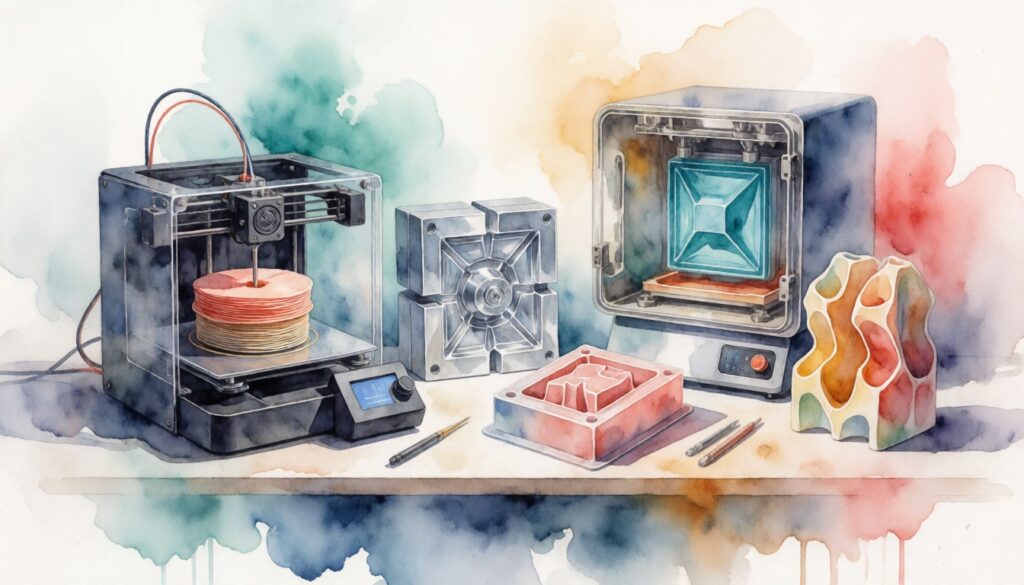
- Additive Manufacturing (3D Printing) — Best for iterative prototyping and low-volume functional parts. It allows design changes without any tooling cost.
- CNC Machining of Prototype Parts — Machined from solid polymer stock, this method delivers production-grade plastic properties plus tight tolerances without a mold.
- Vacuum Casting (Silicone Molding) — Using a flexible silicone mold and polyurethane resins, it produces 10–80 parts quickly in near-production materials.
- Reaction Injection Molding (RIM) — Low-pressure injection of thermoset polymers, ideal for large, structurally complex parts with lower tooling costs.
- Aluminum and Bridge Tooling — A low-volume injection mold cut from aluminum or pre-hardened steel that runs tens of thousands of parts before a standard production tool is justified.
Because every alternative has a different cost curve, COMEKIN recommends mapping each one against your program’s volume and tolerance requirements before investing