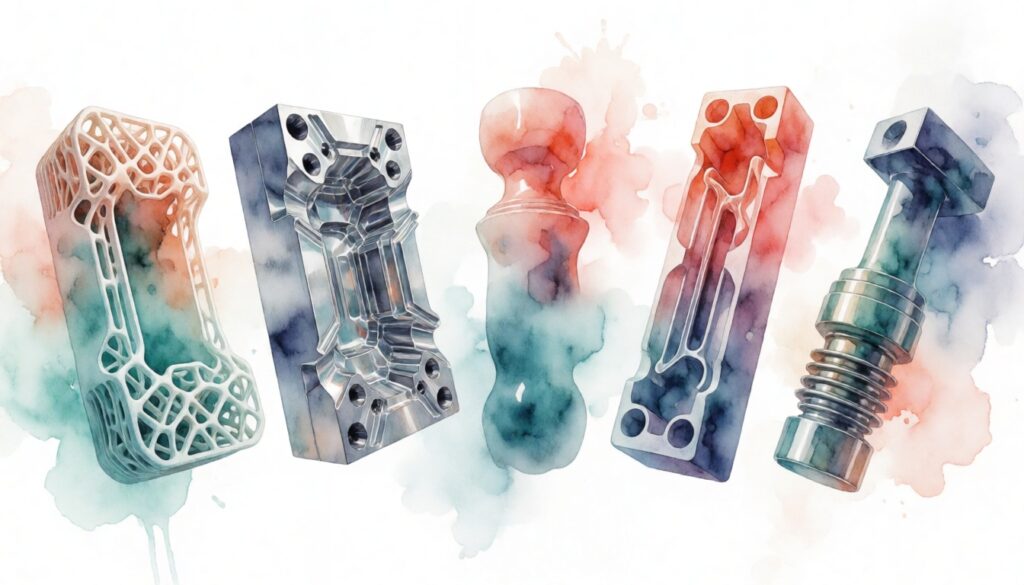
Introduction to Top 5 Alternatives To Standard Molds For Plastic Injection
In the rapidly evolving world of manufacturing, the demand for speed, precision, and cost-effectiveness has never been more intense. For decades, the industry standard has been the use of traditional steel or aluminum multi-cavity molds—a method that requires hefty upfront investments and long lead times. However, as we move through 2026, product development cycles are shrinking, and the need for rapid iteration has pushed engineers and procurement specialists to explore alternative methods. Understanding the Top 5 Alternatives To Standard Molds For Plastic Injection is no longer just an exercise in creativity; it is a critical business strategy that bridges the gap between concept and mass production.
The core issue faced by many OEMs today is the financial risk associated with standard tooling. When you cut a full-production steel mold, you are committing to a specific design, often with tolerances that leave no room for error. If the product fails market testing or requires a design tweak, you are left with a very expensive paperweight. This is where alternative tooling strategies come into play. They offer flexibility, reduced cost, and faster time-to-market without sacrificing the quality required for functional testing or low-volume production runs.
At COMEKIN, we understand that there is no "one-size-fits-all" solution in manufacturing. Our philosophy revolves around matching the right technology to the specific stage of your product lifecycle. Whether you need a bridge to production or a solution for high-mix, low-volume manufacturing, our expertise in plastic injection molds ensures that we deliver engineered solutions that don’t just meet your specifications but optimize your entire supply chain.
Core Benefits & Strategic Importance
Why should you care about deviating from the standard mold design? The benefits extend far beyond just saving a few dollars on the initial tooling quote. By strategically implementing alternatives to standard molds, you can significantly alter the financial and logistical trajectory of your project.
Driving Targeted Audience Engagement
In the "prosumer" and startup era, crowdfunding campaigns often dictate manufacturing success. Backers expect physical prototypes within weeks, not months. Standard mold manufacturing typically takes 6 to 8 weeks for tooling alone. By utilizing alternatives like aluminum inserts or 3D printed soft tooling, companies can ship functional products to early adopters to build brand loyalty. This agility drives engagement because you can pivot based on feedback without the fear of scrapping expensive steel.
Maximizing ROI and Conversion Efficiency
The return on investment (ROI) calculation is drastically different when you work with Top 5 Alternatives To Standard Molds For Plastic Injection. Traditional molds require a high "breakeven" volume—usually in the hundreds of thousands of units—to justify the tooling amortization. Alternative molds lower this threshold significantly. For businesses upscaling from prototype to prototype parts production or launching niche medical devices, this is a game-changer. You can generate revenue from sales before ever committing to the final, high-volume production tool. This "pay-as-you-go" approach to tooling capital preserves cash flow for other critical business areas.
Avoiding Common Pitfalls and Mistakes
One of the most common mistakes in manufacturing is "over-tooling" a product that hasn’t proven its market fit. Teams often rush to a standard Class 101 mold only to realize the fitment, finish, or function is flawed. Alternative tooling acts as a safety net. It allows you to validate mold flow analysis, gate placement, and ejector pin locations in a cost-effective environment. Furthermore, using alternatives allows you to test different resins without committing a massive budget to a machined metal mold bases. This derisks the entire manufacturing process, ensuring that when you do invest in the final production metal, the design is flawless.
Step-by-Step Implementation Guide
Transitioning from a standard mold mindset to a flexible manufacturing approach requires a specific strategy. Here is how you can implement these alternatives successfully in your next project to save time and capital.
Initial Audit and Foundational Setup
Before selecting any alternative, conduct a rigorous audit of your project requirements. Ask yourself three questions:
- Volume: How many parts are needed in the first year?
- Material: What polymer are you running (filled or unfilled)?
- Tolerance: What dimensional precision is truly critical?
If your volume is between 500 and 10,000 units, and you are using unfilled materials, you qualify for alternatives. The foundational setup is selecting the right partner. Look for a manufacturer with a diversified catalog. For example, COMEKIN operates beyond simple injection molding; our familiarity with CNC machining tooling allows us to rapidly cut the precise geometry required for non-standard molds, ensuring a seamless transition between prototyping and production.
Executing High-Impact Action Items: The Top 5 Alternatives
Based on our engineering expertise and current 2026 market trends, here are the top five alternatives to standard molds that are currently delivering exceptional results.
1. Aluminum Injection Molds
When speed is of the essence, aluminum tooling is the undisputed king. Unlike hardened steel (P20 or H13), aluminum (usually QC-7 or 7075) can be machined up to twice as fast. This significantly reduces lead times to as little as 15 business days. Because aluminum dissipates heat much faster than steel, cycle times are often 20-30% faster. However, aluminum is softer. It is ideal for up to 100,000 cycles, making it perfect for Pre-production and bridge production runs. It allows you to validate your product in the intended production resin before investing in steel.
2. 3D Printed Soft Tooling
Additive manufacturing has finally matured enough to jump from prototyping to manufacturing floors. In this method, we 3D print mold inserts (usually using SLA or high-temp resin) that are mounted into a standard Hardware molds frame or a standard mold base. This is not for high-volume production, but it is phenomenal for low-run pilot batches of 10 to 100 parts. The advantage here is the ability to create complex internal conformal cooling channels or intricate geometries that would be impossible to machine. If you need a physical part next week to test CNC machining tooling alignment or final assembly, this is your solution.
3. Metal 3D Printing (Rapid Tooling Inserts)
For those who need higher volumes but still want to avoid the wait of a full steel block, we use Directed Energy Deposition or Metal Binder Jetting to print DMLS cores and cavities. These printed metal inserts (often Maraging Steel) offer hardness close to solid steel. The benefit of this alternative is the ability to create die-sunk features with complex internal geometry for excellent cooling. This alternative is considered "rapid tooling" because it saves the days required to sink the EDM electrode. It bridges a gap between soft aluminum and full-hard steel, handling hundreds of thousands of cycles with ease.
4. Interchangeable Mold Inserts with a Universal Mold Base
One of the most money-saving alternatives is not the material of the mold, but its structure. Instead of cutting a new mold for every single product, you invest in a high-grade standard "master" mold base and create only replaceable inserts. This is the "family mold" concept but taken to the extreme. This reduces the cost of the Metal mold bases significantly because you only pay for the unique cavity inserts, rather than the entire mold frame. This is ideal for products with a common base (like a bottle cap or cartridge) but different logos or upper features. This strategy reduces tooling costs by up to 40% per variant.
5. Bridge Tooling (Pre-Production Molds)
Bridge tooling isn’t necessarily a different material, but a different lifecycle approach. You design tooling with a planned lifespan that aligns with the product launch timeline. While you finalize marketing strategies and secure distribution, you can use factory hard tooling that might not have the 10-million-cycle lifespan of a Class 101 mold, but it gets you to market immediately. This allows you to launch small batches to gauge reception. If the product takes off, you can continue running it as a long-term Hardware molds solution. If not, your losses are contained. This strategic "selling through the tooling" approach is optimal for releasing seasonal products or testing new markets.
Measuring Performance and Scaling Results
Once you switch to these alternative tooling methods, you must track different KPIs than you would for standard production tooling.
- Time-to-Market: Track the days saved from design release to first physical part.
- Tooling Capital Expenditure: Measure the cash flow impact. Did alternative tooling allow you to launch with 50% of the budget you usually allocate?
Scaling results through these alternatives requires a fluid communication loop between your engineering team and the manufacturer. When we at COMEKIN produce solutions for diverse sectors—from angular grinding components to precision drilling solutions—we treat every mold as a fluid iteration. By analyzing the parts produced in an aluminum mold, you can identify wear patterns or flow marks. Utilizing this data to modify the final steel mold ensures that your "go-to-production" phase is perfect.
Conclusion & Key Takeaways
The manufacturing landscape of 2026 demands a dynamic approach to injection molding. Sticking to standard steel molds for every project simply doesn’t align with the financial or speed expectations of the modern market. The Top 5 Alternatives To Standard Molds For Plastic Injection—ranging from Aluminum and 3D printed soft tooling to inserts and bridge tooling—offer a strategic advantage that is vital for remaining competitive.
These alternatives provide a crucial safety net for innovation. They allow you to fail fast and pivot quickly without incurring catastrophic financial penalties. Just as choosing the right molds for plastic injection can define the launch of a product, choosing the right type of mold determines the health of your finances. For products intended for small spaces or compact housing, a heavier, slower-to-produce standard mold might be overkill; a rapid CNC-cut insert provides the required efficiency with minimal risk.
Actionable Next Steps for Long-Term Success
- Evaluate Your Volume vs. Time: Create a matrix of your expected part count against your deadline. If your deadline is less than 4 weeks out, alternatives are non-negotiable.
- Engage Early with Your Tooling Partner: Share your product lifespan goals with the manufacturer before they quote. Let them know—via platforms like COMEKIN—that you are not necessarily targeting millions of parts, asking instead for a strategy that matches your actual production burn rate.
- Validate, Then Commit: Use bridge tooling to supply your first series. Gather real-world performance data on the plastic part, then commit to the final Class 101 steel mold with absolute confidence that you are putting capital into a proven design.
To optimize for the future, you must balance innovation with practicality. By integrating these specific alternatives into your workflow, you will not just be producing plastic parts; you will be engineering a leaner, more responsive business model that thrives in the face of market volatility. Regardless of whether you choose rapid aluminum tooling or the long-term durability of pre-production steel, you are investing in the strategic flexibility necessary to win in 2026.