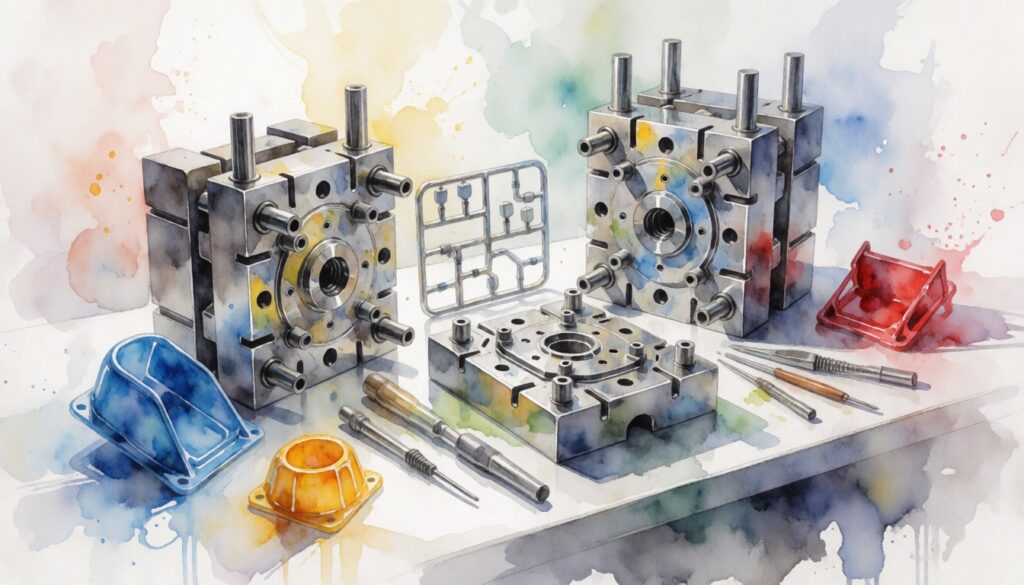
Introduction to How To Make molds for plastic injection
In the rapidly evolving manufacturing landscape of 2026, understanding how to make molds for plastic injection has become a cornerstone of industrial growth and product innovation. Whether you are launching a new consumer product, scaling up an automotive component line, or refining medical device manufacturing, the quality of your injection mold directly determines the quality of your final product. Injection molding remains one of the most efficient and cost-effective methods for mass-producing plastic parts, and the mold itself is the heart of the entire process.
Understanding Why How To Make Molds For Plastic Injection Matters for Modern Growth
The global injection molding market continues to expand, driven by demands for precision, speed, and sustainability. Companies that master mold-making gain a significant competitive advantage because molds dictate cycle times, part tolerances, surface finishes, and overall production economics. A well-engineered mold can run for millions of cycles with minimal maintenance, while a poorly designed one leads to defects, downtime, and runaway costs.
Learning how to make molds for plastic injection is not just a technical skill — it is a strategic investment. It enables faster time-to-market, reduces per-unit costs, and opens doors to complex geometries that would be impossible with other manufacturing methods.
Key Market Trends and Foundational Concepts
Several trends are shaping mold-making in 2026:
- Digital twin simulation: Mold designers now use advanced software to simulate flow, cooling, and warpage before cutting any steel.
- Conformal cooling: 3D-printed inserts with curved cooling channels dramatically reduce cycle times.
- Sustainable materials: Recycled and bio-based resins demand molds engineered for tighter thermal control.
- Automation and IoT: Smart molds with embedded sensors monitor pressure and temperature in real time.
Foundationally, every injection mold consists of two main halves — the cavity and the core — mounted on a Metal mold base. Molten plastic is injected into the cavity, cools, and is ejected as a finished part. Understanding this flow is essential before diving into the step-by-step process.
How COMEKIN Optimizes This Strategy
COMEKIN combines decades of tooling expertise with modern CNC precision to deliver Plastic injection molds that outperform industry benchmarks. From initial design consultation to final validation, COMEKIN streamlines every phase of mold production, helping businesses reduce lead times and eliminate costly rework. Their integrated approach to Hardware molds and precision CNC machining tooling ensures that every mold is built to exact specifications.
Core Benefits & Strategic Importance
Driving Targeted Audience Engagement
A precisely engineered mold translates into products that meet exact customer expectations. When parts fit perfectly, function reliably, and look polished, your brand earns trust. This is especially critical in competitive sectors like electronics, where compact solutions matter — see how COMEKIN addresses this in their guide to Best Injection Plastic Molds for Small Spaces in 2026.
Maximizing ROI and Conversion Efficiency
Mold-making is capital-intensive, so ROI depends on getting it right the first time. Key financial benefits include:
- Lower per-part cost at high volumes: Tooling amortizes quickly once production scales.
- Reduced scrap rates: Precision molds minimize flash, short shots, and sink marks.
- Faster cycle times: Optimized cooling and gating boost output per hour.
- Extended tool life: Proper steel selection and heat treatment delay wear.
Avoiding Common Pitfalls and Mistakes
Many manufacturers stumble because they:
- Skip prototype validation, rushing into hardened steel tooling.
- Ignore draft angles and wall thickness, causing ejection problems.
- Underestimate cooling design, leading to warped parts.
- Choose the wrong steel grade for abrasive or corrosive resins.
Avoiding these errors requires disciplined prototyping. Using Prototype parts allows you to test fit and function before committing to full production tooling.
Step-by-Step Implementation Guide
Initial Audit and Foundational Setup
Before cutting metal, conduct a thorough design audit:
- Define part requirements: Material, tolerances, surface finish, and annual volume.
- Perform DFM (Design for Manufacturability) analysis: Identify thin walls, undercuts, and sharp corners.
- Select mold type: Two-plate, three-plate, or hot runner, depending on part complexity.
- Choose materials: P20, H13, S136, or beryllium copper inserts based on production needs.
- Plan the mold base: A robust Metal mold base provides dimensional stability and alignment.
At this stage, 3D modeling and CAD simulation validate flow, cooling, and shrinkage. Partnering with COMEKIN at this phase ensures your design is production-ready from day one.
Executing High-Impact Action Items
Once the design is locked, manufacturing begins:
- CNC machining: Rough and finish milling of cavity and core blocks using advanced CNC machining tooling. Precision here dictates part accuracy — much like the tolerances discussed in The Ultimate Guide to Grinding in 2026.
- EDM (Electrical Discharge Machining): For intricate details and sharp internal corners.
- Drilling and cooling channels: Properly placed channels ensure uniform cooling. Techniques mirror precision methods covered in Drilling: Types, Methods, and How COMEKIN Provides High-Performance Drilling Solutions.
- Surface finishing: Polishing and texturing to achieve the desired cosmetic finish. Grinding plays a vital role here, as explained in The Ultimate Guide to Angular Grinding in 2026.
- Assembly and fitting: Combining cavity, core, ejector system, and hot runner into a complete Plastic injection mold.
For blow molding applications, similar principles apply, as detailed in The Ultimate Guide to Ace Hardware Blow Molds in 2026.
Measuring Performance and Scaling Results
After the first mold trial (T1 sample), evaluate:
- Dimensional accuracy: Compare against CAD using CMM inspection.
- Cycle time: Optimize cooling and ejection for maximum throughput.
- Defect rate: Track flash, warpage, and short shots.
- Mold wear: Monitor after every production run.
Once validated, scaling involves replicating successful molds, adding multi-cavity versions, and integrating automation. Continuous improvement — through data logging and preventive maintenance — preserves ROI over years of production.
Conclusion & Key Takeaways
Mastering how to make molds for plastic injection is a journey that blends engineering discipline, material science, and precision manufacturing. The key takeaways are clear:
- Start with a rigorous design audit and DFM analysis.
- Invest in quality tooling — from Hardware molds to complete Plastic injection molds.
- Validate with Prototype parts before full-scale production.
- Rely on precision CNC machining tooling and robust Metal mold bases for longevity.
- Measure, iterate, and scale with data-driven decisions.
For businesses ready to elevate their manufacturing capabilities, COMEKIN offers end-to-end mold-making solutions engineered for the demands of 2026 and beyond. The next step is simple: audit your current tooling strategy, identify gaps, and partner with a team that treats your mold as the foundation of your product’s success.